Field notes
Clean ice vs debris-covered ice: why melt rates differ
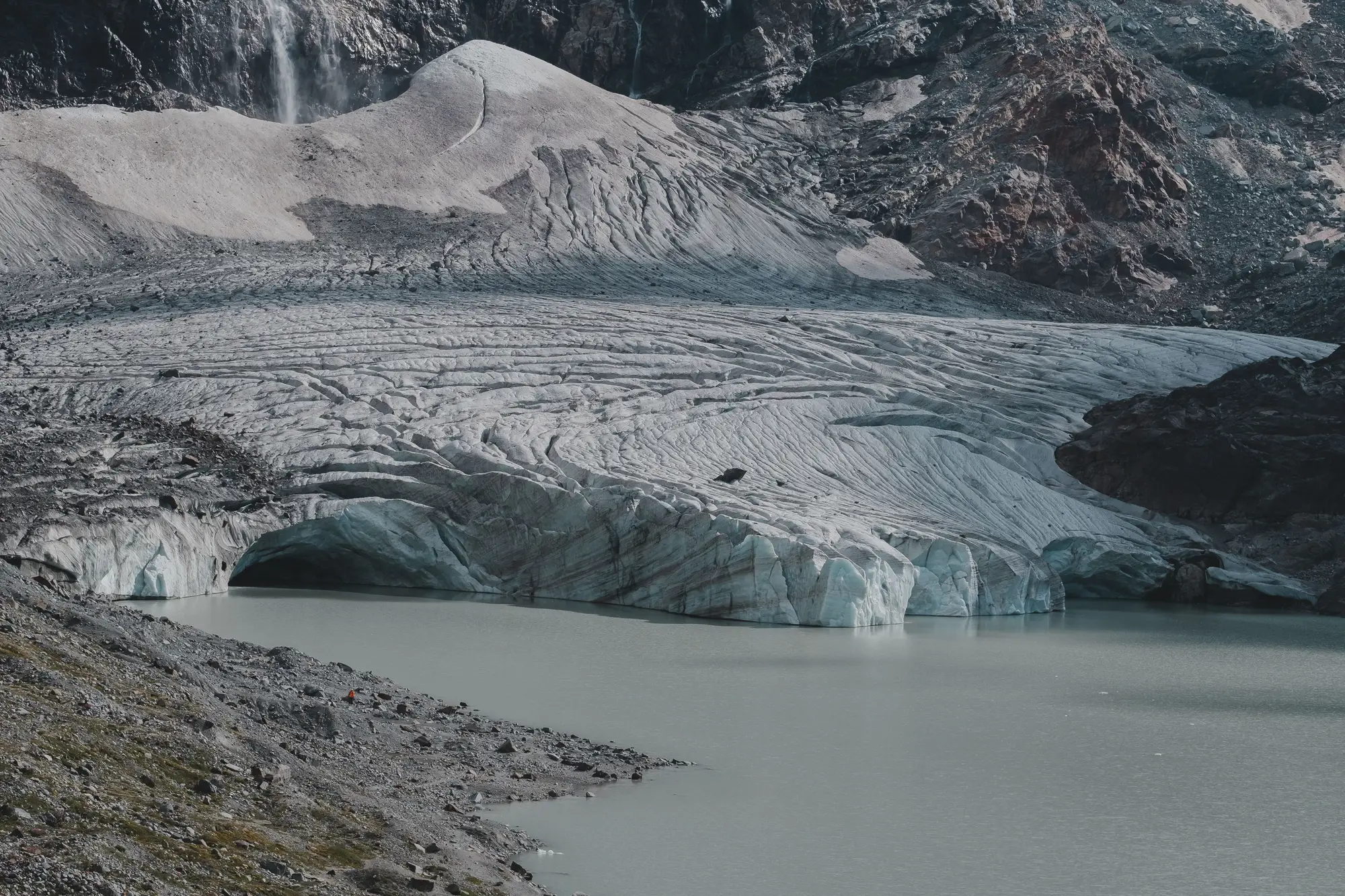
If you've ever compared two glaciers in the same basin and wondered why one tongue is retreating fast while the other barely moves, the answer is often sitting right on top of the ice. A layer of rock debris, sometimes just a dusting, sometimes a meter of rubble, changes how a glacier responds to the same air temperature and the same sun angle. Clean ice and debris-covered ice are not the same hydrological object, even when they started as the same glacier.
Clean ice melts by a simple rule
Bare glacier ice has a fairly predictable energy balance. It's dark compared to fresh snow, so it absorbs more shortwave radiation, and melt tracks closely with air temperature and incoming solar energy. More heat in, more melt out. This is why degree-day models work reasonably well on clean-ice zones: the relationship between temperature and ablation is close to linear, and a warm week produces a proportional pulse of meltwater.
Clean ice ablation zones are also the parts of a glacier easiest to read from a distance. The surface darkens as summer progresses from dust and cryoconite, melt picks up a little, and the whole zone responds together. There's no insulating layer complicating the picture.
Debris cover flips the relationship
A thin coating of supraglacial debris, a few centimeters of fine rock and sediment, speeds melt up rather than slowing it. It lowers the surface albedo even further than bare ice, soaking up more solar energy than clean ice would, and that heat conducts straight down into the ice below. This is the part that surprises people who assume rock cover automatically means protection.
Past a certain thickness, the relationship reverses. Once the debris layer gets thick enough, maybe tens of centimeters, it starts acting like insulation instead of a heat collector. The surface of the rock gets hot in the sun, but very little of that heat makes it through to the ice underneath before nightfall cools things back down. Glaciologists plot this as the Østrem curve: melt rate rises with thin debris, peaks at some critical thickness, then falls off as the debris gets thicker. A heavily debris-mantled tongue can sit there for decades, barely losing mass at the surface, even as the clean-ice zone upglacier is retreating hard.
This is why debris-covered glacier melt doesn't scale cleanly with temperature the way clean-ice ablation does. Thickness varies across the tongue, debris supply changes as rockfall and lateral moraines feed new material onto the surface, and the same glacier can have zones accelerating and zones stalling in the same season.
What this means for a catchment water budget
For a basin that draws on more than one glacier, or on one glacier with both a clean-ice accumulation zone and a debris-mantled tongue, this split matters for timing. A debris-covered terminus can persist as a stagnant ice mass long after the clean-ice portion upstream has thinned and retreated past it, sometimes showing up as buried ice under rock that barely shows in a casual look at the landscape. That buried ice still contributes to late-season flow, but at a rate that has little to do with the air temperature record for that week.
Tracking glacier extent by eye, or relying on a single retreat number for a named glacier, misses this split entirely. What helps is seeing clean-ice and debris-covered zones mapped separately, season over season, across every glacier feeding the catchment, so a thinning clean-ice front doesn't get averaged against a stable debris-covered tongue and read as a flat trend. Glacier Monitoring builds that seasonal ice and snowline extent layer from multi-decade optical archives, so you can see which parts of your basin's ice are losing area and which are just sitting under rock for now.
If separating these two melt regimes across your catchment's glaciers would change how you read your runoff forecasts, that's exactly the gap this site was built to close.